
How legendary loot works in Deadly Days: Roadtrip: rarity, merging, glowing crates, the radar, boss drops, and the fastest ways to farm high-rarity gear.
Deadly Days Roadtrip Legendary Weapons: Sources and Farming
Legendary loot in Deadly Days: Roadtrip is not a separate game. It is the top of the same rarity ladder you climb by merging, crafting, and hammering. That matters because players who chase legendary drops as if they were lottery tickets spend runs underpowered, while players who understand the ladder turn ordinary drops into legendaries on purpose.
Official source: Deadly Days: Roadtrip store page
More sources: Pixelsplit — Deadly Days: Roadtrip and Steam news hub.
The rarity ladder
Items move through a fixed set of rarities. The exact labels in the UI are common, rare, epic, and legendary, with colour coding on the card and the outline. A higher rarity is not a different item; it is the same effect with stronger numbers and, for some items, an additional clause.
There are four ways up the ladder:
- Merge duplicates. Two copies of the same item combine into the next rarity. This is the most reliable path and the one most players underuse.
- Craft. Specific combinations produce specific items, including five craft-only weapons that have no common version.
- Hammer. The Hammer upgrades every marked item one rarity at the end of the day, capped at the Hammer's own rarity.
- Find one. High-rarity crates, bosses, and the Shady Merchant can drop an item already at the top.
The first three are deterministic. The fourth is the one you cannot plan, which is why a farm route should maximise the first three and treat the fourth as a bonus.
Where high-rarity loot comes from
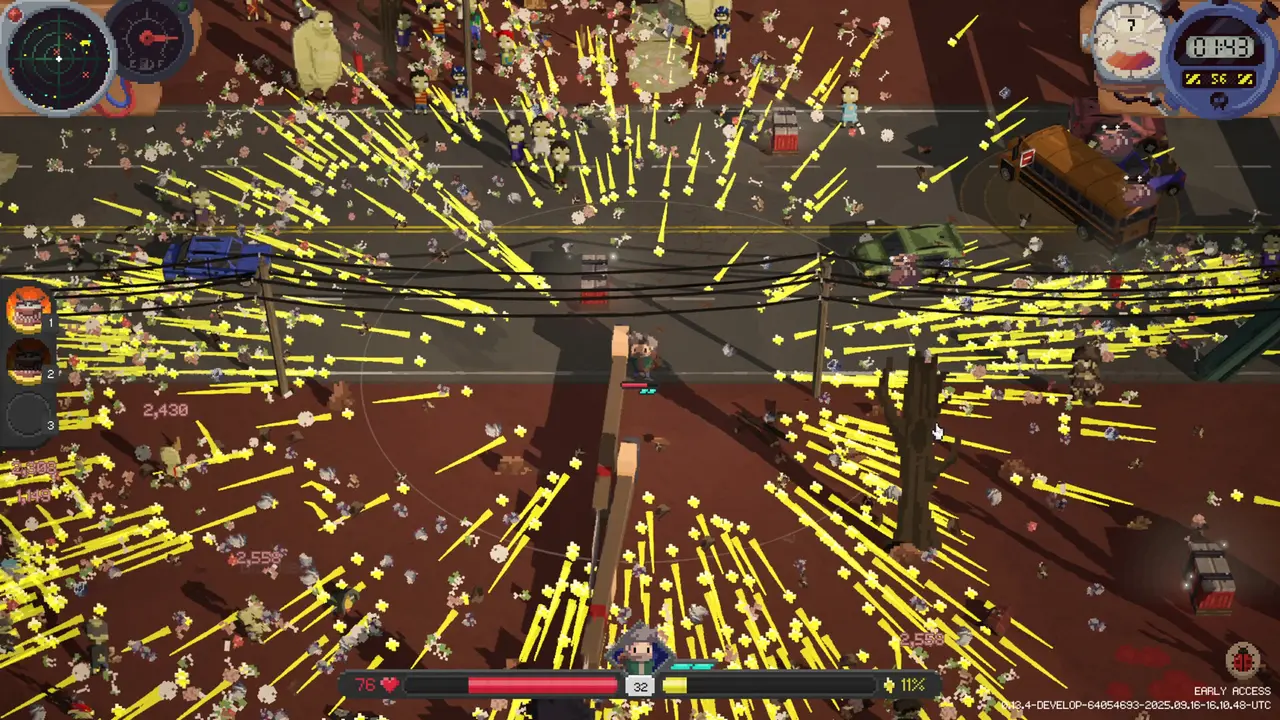
Glowing crates. Since the 0.22 update, loot crates glow according to the highest rarity inside. A crate with a legendary inside is visible from a distance, which turns "should I cross the map" into an informed decision. The glow is a signal, not a guarantee that the item fits your build.
The radar. A one-time unlock that reveals crate and gas-canister rarity on the map. If you are farming a specific slot, the radar is the difference between a route and a wander. Buy it early in your account progression; it applies to every future run.
Bosses. Bosses drop high-rarity gear and duct tape. The tape payout rises at MKing Response Levels 3 and 5, which is why late-run bosses are worth the risk even when the loot is not.
The Shady Merchant. Cursed goods with powerful effects and real drawbacks: the Ripped-Out Eye, the Ice Cube, the Uranium. These are not "legendary" in the strict rarity sense, but they are build-defining and they do not appear in normal crates.
Events. The Space Shuttle, the Labyrinth, and other marked stops have elevated loot tables. They are also fights. Treat the reward as compensation for the risk, not a reason to take it.
Merging is the real farm
The fastest way to a legendary is not a route with more crates. It is a route that lets you merge.
- Take duplicates you do not need. A duplicate of a B-tier item is a rarity upgrade for the A-tier item you actually use, if they are the same item. If they are not, the duplicate is still a future merge for a support slot.
- Keep one empty cell. Merging requires the two copies to meet. A full bag cannot merge.
- Do not sell the second copy for scrap. Scrap buys a rare; the merge buys an epic.
- Merge before the Hammer. The Hammer can lift a different item while the merge handles the duplicate.
A run that merges four times has a better item set than a run that opens twice as many crates and merges none.
The craft-only legendaries
Five weapons exist only through crafting in the 1.0 build: the Flamethrower, the Desert Eagle, the Mega Shotgun, the Crossbow, and The Grinder. The Plasma Hand is a craft-only item that removes the hand limit for weapons. These are not "legendary rarity" by definition, but they occupy the same role: a build-defining item you cannot simply find.
The practical consequence: if you are hunting a legendary weapon and the recipe is available, craft it. A crafted epic with the right mechanic beats a found legendary with the wrong one.
Farming routes that work
Short one-day routes from day four. The Shady Merchant is guaranteed once per run on a one-day route from day four, and the route is short enough to reach the merchant with scrap. This is the target-farm for cursed items.
Bonus XP stages. More levels mean more airdrops, and more airdrops mean more merge fodder. A 150% XP stage is a legendary farm in disguise.
Increased item chance stages. The obvious choice, but only if you have bag space. A loot stage with a full bag is a waste of a modifier.
Boss routes with response level 3+. The duct tape and the high-rarity drop both improve. Do not push to level 6 unless the build is finished.
Buy the radar and use it before you commit to a path. Knowing that the far corner has a legendary crate is only useful if you also know you can reach it before dusk and still fill the gauge.
What to do with a legendary that does not fit
Three options, in order:
- Rebuild around it. If it is an S-tier enabler (Crossbow, Grinder, Plasma Hand), it is worth changing the layout.
- Stash it. The stash persists between runs, so a legendary that does not fit today may fit a future build.
- Sell it. Only if the stash is full and the item is outside every build you play.
Never carry a legendary in the backpack "for later" during a run. It occupies cells that a multiplier could use, and the run ends before "later" arrives.
FAQ
Do legendary items drop from normal enemies? High-rarity drops are concentrated in crates, bosses, and events. Normal enemies are a merge-fodder source, not a legendary source.
Can the Hammer create a legendary? Only if the Hammer itself is legendary rarity. A lower-rarity Hammer caps at its own tier.
Is the Ripped-Out Eye legendary? It is a cursed merchant item, not a standard rarity drop. Its effect is build-defining regardless of the label.
Does rarity affect shape? Some items grow slightly when merged. Check the footprint before you merge in a tight bag.
Related
More Deadly Days: Roadtrip Guides
How Deadly Days: Roadtrip co-op works: couch split-screen, Remote Play Together, controller needs, cross-backpack synergies and shared-run roles.
Deadly Days: Roadtrip codes checked for the 1.0 build: how to redeem, which strings are confirmed, which are community reports, and the scams to avoid.
How crafting works in Deadly Days: Roadtrip: duplicate merging, confirmed recipes, the five craft-only 1.0 weapons, and when to hammer an item.
What duct tape unlocks in Deadly Days: Roadtrip, the reliable sources (bosses, reaper, achievements), and the order worth spending it in.
How Endless Mode scales in Deadly Days: Roadtrip, which builds survive the curve, and the item priorities that stop a finished run from falling over.
The extraction decision in Deadly Days: Roadtrip: reading the fuel gauge, threat level, dusk timing, reaper risk, and the math of one more crate.
A working list of Deadly Days: Roadtrip items: support, trigger, mobility, sustain, cursed merchant goods and character items, with what each one does.
Every Deadly Days: Roadtrip map system explained: biome enemies, fuel icons, shops, event stops, Labyrinth, Pumpkin Patch, and route planning.